
If you run a property business, developer, brokerage, or property manager, this will sound familiar: your listings live in one place, your payment plans live in a spreadsheet, your broker commissions get calculated by hand, your maintenance requests come in over WhatsApp, and by the time anyone asks "how's the portfolio doing this month?" someone has to stitch four different sources together to answer.
We set out to fix that by building a Real Estate Property & Sales Management suite, a full-lifecycle real estate ERP developed natively on Odoo 19. Here's what it does, how it works, and why it actually changes the way a property business runs day to day.
The problem with "good enough" tools
Most real estate operations grow their tooling the way most businesses do: reactively. A CRM here, a spreadsheet there, a separate accounting system, a maintenance log in someone's inbox. Each piece works fine on its own. The problem shows up at the seams: when a unit gets sold in one system but still shows "available" in another, when a broker's commission has to be recalculated manually because nobody trusts the spreadsheet formula anymore, or when an owner asks for a statement and it takes half a day to assemble.
None of that is a people problem. It's a systems problem.
What we built
Rather than bolt a real estate add-on onto a generic project tool, we built this as a native Odoo vertical, meaning it shares the same database, the same accounting engine, and the same user permissions as the rest of a company's operations. No syncing, no duplicate data entry, no "which system is the source of truth" arguments.
Property & unit management. A complete portfolio directory: land and building data, unit-level specs, amenities, media, and pricing, down to individual units within a property. Every unit carries its own live status, Available, Held, Reserved, Sold, Leased, so the whole business is always looking at the same number.
Sales lifecycle. A booking doesn't just sit in a CRM stage, it drives the actual system: Booking, Contract, Collection, Delivery, Maintenance Deposit, with configurable installment plans, automatic invoicing, and automated late-fee handling with tenant and customer reminders.
Leasing lifecycle. Rent schedules, security deposits, renewal reminders, and an occupancy calendar that shows every unit's lease window across the whole portfolio in one view, filterable by building.
Maintenance, connected to availability. When a maintenance job goes active on a unit that's available, the system holds that unit automatically, but never touches a unit that's already occupied or sold. Close the job, and the hold releases on its own.
Broker commissions. Tiered, hierarchical commission rules across both sales and leases, calculated automatically, with a due/paid ledger per broker instead of a side spreadsheet everyone half-trusts.
Owner accounting. Landlord and owner statements generated straight from real rent-collection and maintenance-cost data, not reconstructed after the fact.
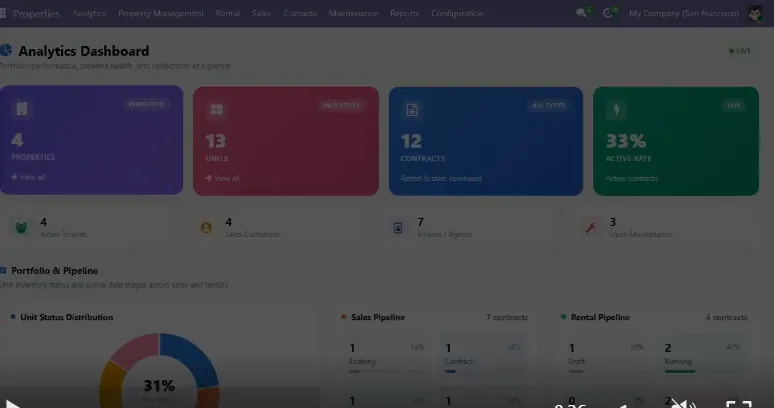
A live analytics dashboard. Occupancy, sales and rental pipeline health, and collections, all in one screen, backed by the same data every other part of the system uses.
How it actually works, end to end
A booking comes in and automatically reserves the unit, no manual status update required. The sales team moves it through Contract, Collection, and Delivery, with an installment plan and invoices generated at each stage. A broker's commission calculates itself based on the deal size and the firm's tiered rules. If a payment goes overdue, the system applies the late fee and notifies the customer. Maintenance comes in, a unit gets held automatically if it needs to be, and releases itself when the work is done. At any point, a manager opens the dashboard and sees exactly where every deal, every unit, and every dollar stands, because it's all one system, not four.
Why it's worth doing this way
One source of truth: a unit's status is a single fact, not four different opinions across four different tools. Nothing falls through the cracks by design, late fees, renewal reminders, and availability holds happen automatically instead of relying on someone remembering to check. It scales with the business, not against it, because it's built on Odoo, it grows into Accounting, Analytics, HR, and whatever else the business already runs, instead of becoming yet another silo to maintain.
Who this is for
Real estate developers managing new inventory through delivery. Brokerages running sales and leasing side by side. Property managers who answer to owners and need statements they can trust. Anyone tired of asking "which spreadsheet is the real one?"
Comments 0
No comments yet.